Tuesday, 30 November 2010

League Cup : West Ham thrash Man Utd in Carling Cup

West Ham   4 - 0   Man Utd 

Spector celebrates the second of his two first-half goals with team-mate Obinna


By Chris Whyatt

Rampant West Ham booked a first League Cup semi-final for 20 years after knocking holders Manchester United out of the Carling Cup at snowy Upton Park.
Former Red Devil Jonathan Spector was in inspired form, scoring with a header and a close-range finish to notch his first goals in English football.
The disjointed visitors, previously unbeaten this season, conceded again as Carlton Cole nodded in after the break.
Cole then turned Jonny Evans to fire simply past Tomas Kuszczak.
Though Manchester United manager Sir Alex Ferguson predictably did not select his strongest team, the starting XI could still boast the likes of Ryan Giggs, Darren Fletcher and Javier Hernandez.
So it still registers as something of a shock that West Ham, bottom of the Premier League, ran out such convincing and deserved winners against the league leaders - especially in light of the Londoners' poor start to this season.
And under-pressure Hammers boss Avram Grant may now insist they are over their bad patch after a performance that was rich in promise, both individually - Nigerian striker Victor Obinna was hugely impressive as he created all four goals - and collectively.
The match started fast in freezing conditions, with both teams attacking each other as the play moved swiftly from end-to-end.
West Ham could have suffered a dispiriting early deficit but for the heroics of England squad goalkeeper Robert Green, so maligned after his disastrous World Cup campaign.

Read full story >>>>>

Source : BBC

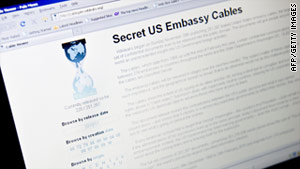
WikiLeaks reports another electronic disruption

Washington (CNN) -- After posting thousands of secret government documents, WikiLeaks came under an electronic attack designed to make it unavailable to users, the whistle-blower website said Tuesday.
The site also experienced a distributed denial of service (DDOS) attack on Sunday, just as it was publishing the first of what it says are 250,000 secret U.S. diplomatic cables. Such attacks normally are done by flooding a website with requests for data."DDOS attack now exceeding 10 Gigabits a second," WikiLeaks said on Twitter.
The effects of Tuesday's electronic disruption were unclear.
WikiLeaks recovered from Sunday's disruption and began publishing cables from U.S. embassies around the world, documents that the website said represented the largest-ever disclosure of confidential information. Those documents give the world "an unprecedented insight into the U.S. government's foreign activities," the site said.

Read full story >>>>>

Source :  CNN

Wikileaks row: China wants Korean reunification, officials confirm


China supports the "independent and peaceful reunification of the Korean peninsula" and cannot afford to give the North Korean regime the impression it has a blank cheque to act any way it wants, Chinese officials based in Europe said today.
The officials, who asked not to be identified, spoke after the Guardian revealed that senior figures in Beijing, exasperated with North Koreabehaving like a "spoiled child", had told their South Korean counterparts that China was leaning towards acceptance of reunification under Seoul's control.
China's moves to distance itself from the North Korean regime were revealed in the latest tranche of leaked US embassy cables obtained byWikiLeaks and published yesterday by the Guardian and four international newspapers.


One Chinese official said today reunification was not going to happen overnight and China's first priority was to calm down the situation, restart a dialogue, and maintain stability in the region. But Beijing had always backed peaceful reunification as a longer term goal.
The officials admitted to a sense of frustration in Beijing over North Korea's recent actions, including its nuclear and missile tests – which China opposed – and last week's lethal artillery bombardment of a South Korean island.
A general discussion was continuing about the direction of North Korea policy, another official said. North Korea produced strong feelings among the Chinese leadership and public, and China had to be careful. Beijing wanted to maintain its friendship with Pyongyang. But it did not want to be led by the nose.
The officials expressed optimism that talks between the North and its regional interlocutors, South Korea, China and Japan, could be successfully restarted, despite Washington's dismissal of China's proposal as "PR activity".
South Korea might be tempted to indulge in tit-for-tat actions against the North, one official said. But a new war on the peninsula was unimaginable; it would be devastating for the two Koreas and for the region as a whole. Therefore China was trying to provide a steadying hand. If the current tense situation was allowed to escalate, North Korea was capable of taking radical actions.
The officials said the Chinese government was talking to the North on a regular basis; there were many channels that could be used. But the North was a proud nation and China could not ultimately control it, they said. Beijing told the North's leaders what it thought – but sometimes they behaved irrationally.
"We do not have an effective way to influence them. Sometimes when we try it only makes things worse," a senior Chinese diplomat said.
Referring to last week's artillery attack, the diplomat said it could be part of what North Korean leaders described was their strategy of "setting a fire under the Americans" in order to get their attention and win concessions.
There was growing evidence the Chinese public was running out of patience with the North's behaviour and this influenced the Chinese leadership's thinking, the diplomat said, adding that, in short, there was a limit to China's patience.
Officials described the WikiLeaks disclosure of secret and classified US embassy cables relating to the Korean question as mischievous. When reading the diplomatic reports, they said, it was essential to distinguish between the personal opinions of those quoted and official government policy.
The Chinese foreign ministry spokesman noted the WikiLeaks reports and urged the US to "appropriately resolve related issues" before declining further comment.

Source : guardian.co.uk

Medvedev: Russia, NATO must reach missile deal

MOSCOW - NATO's failure to build a joint European missile shield with Moscow may force Russia to deploy new offensive weapons and trigger a new arms race, Russian President Dmitry Medvedev said Tuesday in a stern warning reflecting the deeply rooted Kremlin distrust of Western intentions.

Some experts downplayed the threat, saying that Russia lacks money and technologies to mount a military buildup.

NATO leaders have approved a plan for a missile defense in Europe at a summit in Lisbon earlier this month and invited Russia to join. Experts from both sides will analyze the issue and report to defense ministers in July.


"In the next 10 years, the following alternatives await us , either we reach agreement on missile defense and create a full joint cooperation mechanism, or, if we don't reach a constructive agreement, a new phase of the arms race will begin," Medvedev said in his annual address to both houses of parliament that burst into the loud applause. "And we will have to make a decision on deploying new means of attack. It's quite obvious that such a scenario would be extremely grave."

Medvedev, who attended the Russia-NATO summit in Lisbon, was receptive of NATO's proposal but didn't make a definitive commitment. He warned then that Russia might decide against joining the U.S.-led effort if it doesn't feel it is being treated equally as a partner.

Medvedev's aide Arkady Dvorkovich told reporters Tuesday that the president views that scenario as "undoubtedly negative." "We will have to do everything to come to an agreement," he said.

Russia was strongly critical of the previous U.S. administration plan to deploy missile defense sites in Poland and the Czech Republic and hailed President Barack Obama's decision to scrap it. But Moscow has remained concerned about the revamped U.S. missile defense plans, seeing them as potentially dangerous to its security.

The New START nuclear arms reduction treaty that Obama and Medvedev signed in April doesn't prevent the U.S. from building new missile defense systems, but Russia has stated it could withdraw from the treaty if it feels threatened by such a system in the future. The pact's future look bleak now after a key Senate Republican said earlier this month that he does not want to vote on the treaty during the current session.

In Moscow on Tuesday, some experts viewed Medvedev's warning about the possibility of a new arms race with skepticism, saying that it could be part of muscle-flexing aimed at speeding up talks with the West and emphasizing that Moscow can't afford a Cold War-style arms race anyway.

"This is sheer nonsense," Alexander Konovalov, director of the Moscow-based Institute for Strategic Assessment, an independent think tank, told The Associated Press. "Russia won't have the finances, technologies and industrial assets for any arms race."

Pavel Felgenhauer, an independent Moscow-based military analyst, also noted that despite the Kremlin's recent efforts to modernize military arsenals, Russia's current scientific and financial capabilities are far weaker than the Soviet military machine. "Because of Russia's technological backwardness, a real build-up is impossible," he said.

Despite such limitations, some observers say that Russia's hawkish military officials and defense corporations have been pushing for more spending on new weapons.

"We have enough corporations, groups and institutions that would push for the development of a multitude of new arms systems," foreign policy analyst Alexei Arbatov was quoted as saying by RIA Novosti news agency.

Apart from the technological weaknesses, the Russian military also faces a manpower shortage. The problem is partly related to the demographic plunge Russia has faced after the Soviet collapse.

Medvedev dedicated part of his 72-minute address to the problem, exhorting lawmakers to make improving the lives of children Russia's top task and proposed giving free land to families with three or more children.

Because of high mortality rates and a declining birth rate, Russia's population shrank some 7 million people from its 1991 high. However, the country reported a small population increase last year, to 141.8 million.

,,,,

Associated Press writers Jim Heintz, David Nowak, Nataliya Vasilyeva and Vladimir Isachenkov contributed to this report.

Source : Philly

Date Set for Nuclear Talks With Iran

TEHRAN — Iran and the European Union agreed on Tuesday to a date and time for nuclear talks in Geneva next week, but President Mahmoud Ahmadinejad insisted in a speech that Iran would not give “one iota” in the discussions.

The meeting between Saeed Jalili, Iran’s top nuclear negotiator, and Catherine Ashton, the European Union’s foreign policy chief, would be the first high-level negotiations in more than a year and comes amid revelations, in leaked diplomatic communications, of widespread concern among Iran’s Arab neighbors about its nuclear program. The agreement on when to hold the meeting also came a day after the killing of an Iranian nuclear scientist in Tehran.

Speaking to a crowd of supporters in northern Iran on Tuesday, Mr. Ahmadinejad took a hard stance ahead of the talks. Iran had always been willing to talk “under the conditions of justice and respect,” he said, but added that “the people of Iran will not back down one iota” on demands to curb the nation’s nuclear program, which Iran claims is directed only at nonmilitary purposes.

Mr. Ahmadinejad appeared to frame the Geneva meeting, scheduled for Dec. 6 and 7, in terms of the economic sanctions imposed by the Western powers. “I advise that if they want to get results from these talks, they must put aside their outdated behavior” in order to talk “about international cooperation, solving the problems of humanity and about economic and nuclear issues,” he said in a speech that was broadcast on state television.

In the view of American and European officials, Iran’s new willingness to engage in talks may indicate that new and tougher sanctions, approved this year, are having an effect on its troubled economy.

Officials from the United States, Russia, China, France, Germany and Britain are expected to attend the meeting, although Ms. Ashton said she would negotiate with Iran “on behalf” of those six nations, her office said in a statement confirming the meeting.

On Monday, attackers riding motorcycles killed one prominent Iranian nuclear scientist and wounded another in separate bombings in Tehran. The scientist who survived, Fereydoon Abbasi, is on the United Nations Security Council’s sanctions list for ties to the nuclear effort, and the highly targeted nature of the attacks led to accusations of a renewed effort by the United States and Israel to disrupt Iran’s program.

In diplomatic cables revealed by the Web site WikiLeaks on Sunday, Arab allies of the United States, including King Abdullah of Saudi Arabia, candidly voiced concerns over the leadership of Mr. Ahmadinejad and Iran’s path on nuclear weapons.

William Yong reported from Tehran, and J. David Goodman from New York. Stephen Castle contributed reporting from Brussels.

Source : The New York Times

EU and Africa urge peaceful Sudan referendum

TRIPOLI (Reuters) - The European Union and African states urged Sudan's government on Tuesday to accept the results of next year's referendum on whether the oil-producing south of the country should secede.


The January 9 referendum, part of a peace agreement that ended decades of north-south civil war, is likely to produce a vote in favor of independence, diplomats and analysts have said, but it also could be a flashpoint for renewed conflict.
Concerns over the referendum were reflected in a declaration adopted at a summit of EU and African Union states in Libya.
"On Sudan, we emphasize the urgency and importance of ensuring that all elements of the CPA (Comprehensive Peace Agreement) ... are implemented in a timely, peaceful and credible manner, in particular the referendum on South Sudan whose results should be accepted by all," it said.
The EU-Africa summit was the first in three years and was aimed at hammering out joint approaches between the two blocs on issues such as aid, trade, security and immigration.
Other provisions in the final declaration were:
-- The EU and Africa "firmly condemn all unconstitutional changes of governments, which, alongside bad governance, are one of the main causes of instability."
This was a reference to a spate of coups d'etat which have tested the resolve of African leaders to end the practice of military strong-men seizing power by force.
-- The draft tiptoed around the issue of the International Criminal Court's indictment of Sudanese President Omar Hassan al-Bashir on war crimes and genocide charges.
The EU and some African states back his arrest, but others say the court is being used as a political tool of the West. Sudan said it was boycotting the summit in protest at EU pressure for Bashir to stay away.
The document said the EU and Africa are united in the fight against impunity and acknowledge the need to prosecute the most serious crimes, but it did not mention the court itself.
"We are not against the International Criminal Court," Jean Ping, the African Union's top diplomat, told reporters.
"We are against two-speed justice, where the little people, the chicken thieves, are taken to task, while the big bandits are allowed to go free."
-- Europe and Africa committed to concluding a set of stalled trade deals, known as Economic Partnership Agreements.
The deals are deadlocked because some African countries feel the EU is asking them to remove barriers to trade while not doing enough to help them develop their own economies.
"There was a clear commitment to speed up our work on that matter," European Commission President Jose Manuel Barroso told a news conference. "In fact, on behalf of the European Union I committed to use our flexibility addressing the concerns raised by the African side."
(Additional reporting by Salah Sarrar; Writing by Christian Lowe; Editing by Maria Golovnina)

Source : Reuters 

Obama, Hill leaders to meet: taxes, treaty on tap

WASHINGTON – House and Senate leaders from both parties sat down Tuesday for their first postelection meeting with President Barack Obama in an atmosphere charged with tension over taxes and a new nuclear arms treaty with Russia.
Republicans set the tone for the session early, declaring steadfast opposition to any tax increases when the current Bush era tax cuts expire at the end of the year. Obama has said he would oppose a permanent extension of the tax cuts for taxpayers earning more than $200,000 as individuals and $250,000 as couples.
At the same time a couple of Republican senators signaled possible movement on the START treaty which would reduce nuclear weapons arsenals in the U.S. and Russia. Obama has made approval of the treaty this year a top national security goal.
The midmorning meeting came a day after Obama, pre-empting the Republicans, announced he was proposing to freeze the salaries of some 2 million federal workers for the next two years. The White House talks Tuesday were seen as an opportunity for the two parties to size up each other even as they struggle for common ground on taxes, START and other issues on the legislative agenda before Congress adjourns for the year.
Speaking ahead of the meeting, House GOP Whip Eric Cantor said his party wants to "make sure no one gets a tax hike while we're trying to create jobs in the private sector."
And Senate minority Leader Mitch McConnell, R-Ky., delivered a stinging critique of Democratic suggestions to only increase taxes on taxpayers with incomes of more than $1 million.
"It turns out this figure has no economic justification whatsoever," McConnell said. "Nowhere will you find a study or survey which indicates that raising taxes on small businesses with over $1 million in income will create jobs or help spur the economy."
Tuesday's meeting, scheduled for one hour, was the first formal sitdown among the president and the bipartisan leadership since the GOP recaptured control of the House and narrowed the Democratic majority in the Senate in the Nov. 2 elections. Also attending the meeting were Treasury Secretary Timothy Geithner and White House budget director Jacob Lew.
The meeting comes as a new Associated Press-CNBC Poll shows most people oppose extending expiring tax cuts for the richest Americans. Just 34 percent want to renew tax cuts for everyone; 50 percent prefer extending the reductions only for those earning under $250,000 a year; and 14 percent want to end them for all.
On START, Arizona Sen. Jon Kyl, one of the Republicans invited to Tuesday's meeting, has rejected the administration's assertion that the treaty must be dealt with during the lame-duck session, saying the Senate has more pressing issues to deal with.
But Sen. John McCain appeared to leave open the possibility of working with the White House, saying he still hoped progress could be made this year.
"I believe that we could move forward with the START treaty and satisfy Sen. Kyl's concerns and mine about missile defense and others," McCain said on ABC's "Good Morning America."
Sen. George Voinovich, R-Ohio, who earlier this month raised concerns about the treaty's impact on the former Soviet satellite nations, told reporters, "I'd like to get it done, but in my conscience I want to feel it's the right thing to do."
Sen. Mark Kirk, R-Ill., was asked about the latest wrinkle, Russian President Dmitry Medvedev's warning that a new arms race will erupt if Russian can't agree with the West about a joint European missile defense program.
"I'm open-minded and this is one of the issues I'll raise with the State Department briefing teams coming up to talk to me," he said.
Obama said Monday he hopes Tuesday's White House session "will mark a first step toward a new and productive working relationship, because we now have a shared responsibility to deliver for the American people on the issues that define not only these times but our future."
Despite their political gains, Republicans approached Tuesday's session with some apprehension. Presidents typically gain a public relations advantage by inviting leaders of the opposition party to the White House.
Many Republicans still bristle at the health care summit that Obama called last February. Democrats got more time to make their case than Republicans, and the session yielded no Democratic compromises.
Cantor accused Obama of engaging in "class warfare." "This country is about making sure everyone has a fair shot," he said in an interview.
Source :  Yahoo! News